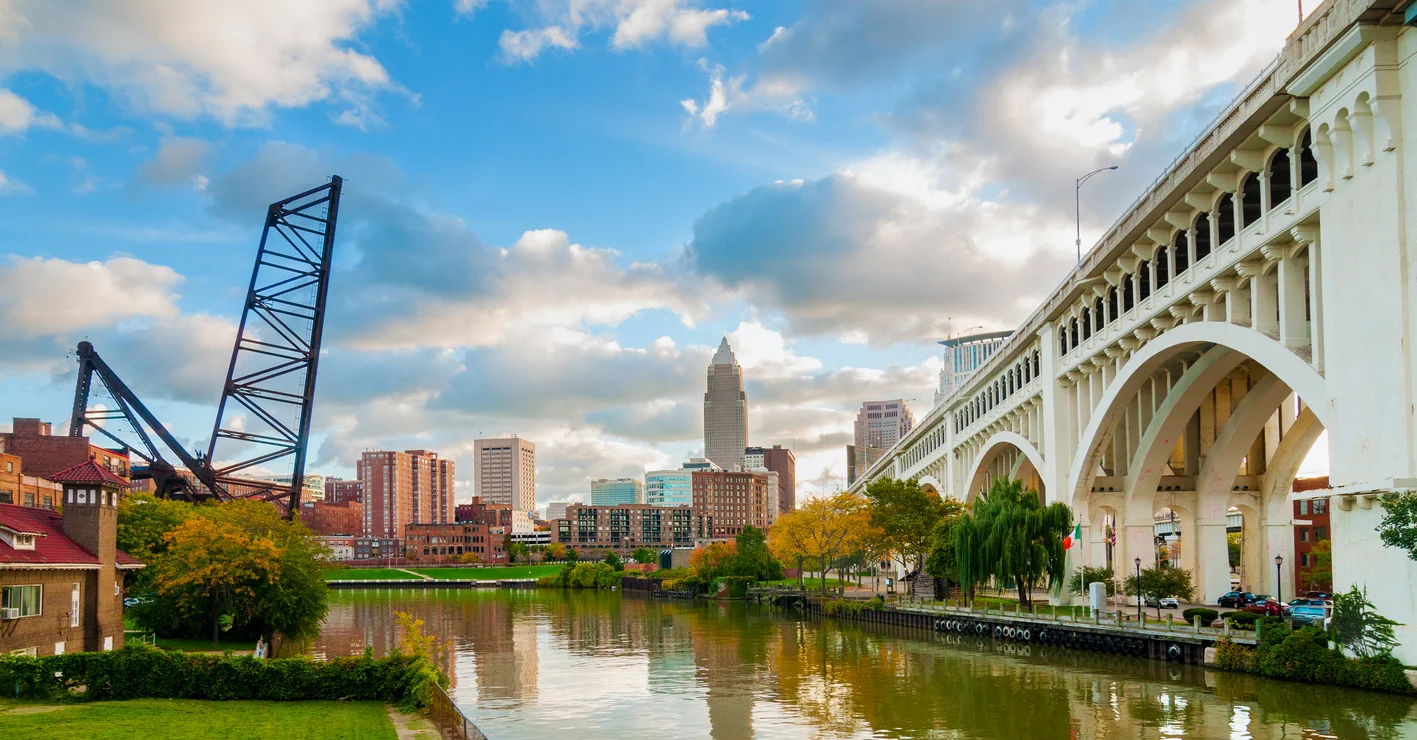
Columbus, Cleveland, Cincinnati, Toledo, Akron, Dayton, Canton and Youngstown have been the drivers of Ohio’s economy for most of the 20th century. Today, however, these “Big Eight” cities are experiencing sustained, long-term population loss, turning them into Ohio’s “shrinking cities” and prompting city and state officials to ask: How will they reshape and reinvent themselves?
Ohio’s Cities At A Turning Point: Finding the Way Forward attempts to answer just that question. The white paper released today by the Greater Ohio Policy Center and the Brookings Institution’s Metropolitan Policy Program lists 10 policy recommendations to guide leaders as the cities undergo a physical transformation. Lavea Brachman, co-director for Greater Ohio and a non-resident senior fellow for the Brookings Institution, co-authored the paper along with Alan Mallach, non-resident senior fellow for the Brookings Institution.
According to the white paper, the following seven premises must frame any vision for recreating the physical footprint of Ohio’s largest cities:
These cities contain significant assets for future rebuilding.
These cities will not regain their peak population.
These cities have a surplus of housing.
These cities have far more vacant land than can be absorbed by redevelopment.
Impoverishment threatens the viability of these cities more than population loss.
Local resources are severely limited.
The fate of cities and their metropolitan areas are inextricably inter-connected.
Specific recommendations from Ohio’s Cities At A Turning Point include the call for joint regional planning and economical development; targeted, strategic investment of resources; prioritization of state funding to cities adopting proactive plans that address their population loss and need for land reconfiguration; and local government consolidation where appropriate.
Greater Ohio Policy Center, in partnership with the Brookings Institution Metropolitan Program, today proudly released our widely anticipated Restoring Prosperity: Transforming Ohio’s Communities for the Next Economy with an event at the Statehouse Atrium attended by community, political and business leaders throughout the state. Please check out our Restoring Prosperity Initiatives page to learn more about this exciting, action packed report and sign up to become a Greater Ohio Supporter to be kept up-to-date as we work together to move this agenda forward.
Greater Ohio Policy Center was pleased to attend yesterday’s press conference where it was announced that Ohio would receive $400 million in federal stimulus funds to be used to fund the 3C Corridor “Quick Start” passenger rail system between Cleveland, Columbus, Dayton and Cincinnati. Greater Ohio applauds the state for taking the steps necessary to capitalize on this unique opportunity offered by the American Recovery and Reinvestment Act to jump-start development of convenient and affordable rail service between core cities within our great state. This announcement marks real progress and marks a milestone in the effort to bring our state’s transportation system up to a world-class level.
For all of you who have a vested interest in the Great Lakes area, which bascially pertains to all Ohioans, an interesting Summit is set to occur in Buffalo, NY tomorrow to discuss new opportunities to create Great Lake Metros. The Great Lakes Metros and the New Opportunity Summit:Remaking Policy and Practice in a Time of Transformation, will discuss best practices in the implementation of the Obama stimulus, the prospects of regional planning and metropolitan governance, and the development of a sustainable and equitable economy in Great Lakes metro regions. There will be over 50 panelists from 10 major cities in the Great Lakes Area and it should prove to be an engaging experience.
The discussion around creating metro areas that work together is an important one and Ohio needs to make sure they are involved in what is happening. We live in a regional economy and until Ohioans recognize this and cities, counties and townships need to work together if we want to grow the economy.
Columbus, Ohio (June 16, 2009) – Greater Ohio, the state’s “smart growth” organization, is pleased to announce several key hires to expand its policy expertise and meet new opportunities.
Dawn Larzelere, a veteran policy professional with experience working in various roles for three Ohio governors, has been named Policy Director. She brings to Greater Ohio her capacity for policy development and lobbying in federal and state government, and strategic relationship-building across the state and country. Prior to joining Greater Ohio, she was the Legislative Director for the Ohio Housing Finance Agency, and has also served as the Executive Assistant for Business and Industry for Governor Bob Taft and Manager of the Governor’s Regional Economic Development Offices. Dawn graduated from Bowling Green State University with a Bachelor’s Degree in Journalism.
Katherine Buckingham has been promoted from Research Associate to Outreach Coordinator. Katherine replaces Ann Seller, who successfully spearheaded Greater Ohio’s outreach work to reach out to and revitalize Ohio communities. Ann is leaving Greater Ohio to attend law school at the University of Virginia. Katherine graduated from Oberlin College, where she received a Bachelor’s Degree in Politics with an International Studies Concentration. She also gained local Ohio experience through an internship with Hamilton County Commissioner Todd Portune.
Zachary Crafton has been hired as a Research Associate. Zachary received his Bachelor’s Degree in Geography, with a dual emphasis on urban and environmental issues, from Ohio University and his Master’s Degree in Geography from the University of Toronto, with a focus on urban geographic issues.
“These new hires bring diverse and multi-faceted strengths and backgrounds to the Greater Ohio team, and uphold our continued commitment to remain non-partisan,” stated Gene Krebs, Co-Director.
“The experience and education of these three staff members enhance our team and strategically position Greater Ohio to take full advantage of unprecedented opportunities for advancing the Restoring Prosperity to Ohio Initiative and state reform policies,” said Lavea Brachman, Co-Director.
For those of you in the majority who find it confusing to track where the federal stimulus funds are going, Ohio’s Auditor has made it a little bit easier for you. Auditor Mary Taylor has set-up the Ohio Stimulus Tracker to track stimulus funds in Ohio by County and allows users to see how much has been awarded to local governments and organizations in each county. This is a great resource to help Ohioans understand exactly where federal stimulus dollars are going, how those tax dollars are being spent and if they are meeting the federal expenditure requirements.
Smart Growth America is excited to announce the official launch of Streetsblog Capitol Hill. With major transportation, climate and energy legislation coming before Congress in the next year or two, the Livable Streets Initiative felt that it was critical to have a talented journalist down in Washington D.C. covering the issues on a daily basis.
Broadly speaking, the blog will do two things. First, it will aim to make it a high-quality daily source for news and analysis of federal transportation policy and related issues; a daily must-read for the advocates, lawmakers, Congressional staffers, urban planning practitioners, policy wonks and lobbyists who are working to shape the future of America’s transportation systems.
The second goal for Streetsblog Capitol Hill is to help bring outsiders into the federal transportation policy-making process. For decades, transportation policy on Capitol Hill has mostly been an arcane, complex insiders game — a game that’s been played best by highway lobbyists. Streetsblog Capitol Hill will put locally-oriented livable streets advocates on the playing field and help them better understand the rules of the game. As the 293 bloggers who are now members of the Streetsblog Network make clear every day, a vibrant, grassroots movement for sustainable transport, smart growth and livable streets is active and growing increasingly powerful in cities and states nationwide. Streetsblog Capitol Hill will help connect these local activists to the important action taking place inside the Beltway.
Greater Ohio’s Gene Krebs talks with Sue Douglass, Belmont County Department of Development’s Associate Director, about ongoing development activities in the area and road blocks it is facing.
The Columbus City Center is schedule to be taken apart and transformed into a green space beginning this July.
“Capitol South announced a plan in February to replace the failed mall with Columbus Commons, which will open as a 9-acre park in late 2010 and evolve over the next decade into a new retail center that also has homes and office space.” -Columbus Dispatch, Mall set to come down in Summer
The blog, Unplanned U.S. outlines the main reasons the 20 year old mall failed to survive: “Unfortunately the suburban-style design, with very few connections to the surrounding neighborhood, hastened its demise.”
Is is a good thing to tear down a mall that is structurally sound and relatively young in age? While the plan to add a greenspace in the downtown area is appealing, who is going to utilize this area? Columbus’ downtown area is vacant after the workday and unless entertainment and easy access come along with this greenspace, I fear it may go to the wayside as well.
Everyone knows about the troubles Cleveland and Detroit are facing due to vacant and abandon properties. However, the news often forgets to highlight the innovative practices people are employing in order to fix the situation. On Friday, The Wall Street Journal decided to focus on one of the many positive activities that artists are doing to restore prosperity to these hurting cities in the article Artists vs. Blight
Artists in Cleveland have decided to look at vacant properties as an opportunity to create galleries and creative workspace at an affordable price. “n neighborhoods pocked by vacancies, artists have started filling the void. Last November, Katherine Chilcote, a local painter, bought a boarded-up, bank-owned house for $5,000 in Cleveland’s Detroit-Shoreway neighborhood, where one in four family homes has gone into foreclosure in the last three years. Thieves had stolen the doors, punched out windows and ripped out all the pipes, sinks and electrical wiring. Eight cats had moved in.
The 29-year-old artist and four friends spent months ripping up moldy carpet, laying down new tiles and hardwood floors, repairing walls and stripping peeling paint. She bought the empty, weed-filled lot next door for $500. She plans to build a sculpture garden there, with large, whimsical mobiles that twist in the breeze. She’s applying for grant money from the Cleveland Foundation to turn four more vacant houses in the neighborhood into artist residences and studios.” Read the entire article
Although times appear desperate at the moment, it is important to get site of the opportunities available in times of distress and follow the example of innovative people such as the artists in Cleveland, Ohio.