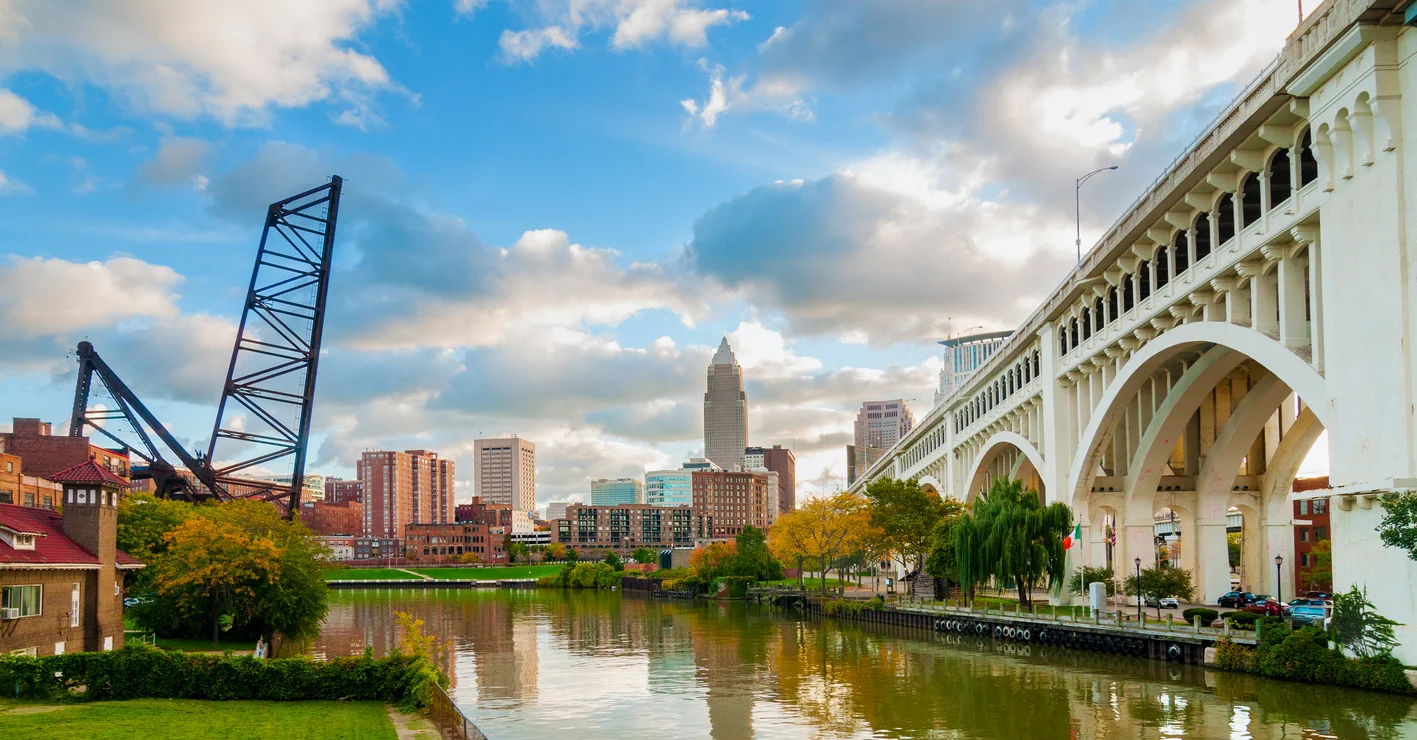
June 18: GOPC and Federal Reserve Bank of Cleveland Host Third Small Communities Workshop

June 10th, 2013

The Three C’s: Comprehensive Community Code Enforcement

On June 18, “The three c’s: comprehensive community code enforcement” will discuss how to develop and implement code enforcement strategies based on strategic community development and neighborhood priorities; the importance of collecting liens; using nuisance abatement powers more aggressively; engaging residents and nonprofits as the eyes and the ears of the community; and evaluating changes to state and local law/modernizing codes to better fit the community’s current condition.

Please click here to register.

http://greaterohio.org/outreach/small-community-workshops

Attending the American Planning Association National Conference

May 8th, 2013

By John Gardocki, GOPC Undergraduate Intern

The APA held its national conference in Chicago this year with the theme of “Planning Big.”  The conference was in April and I was fortunate to have the opportunity to attend the conference as a student member of the APA. The planners and speakers were willing to share their unique experiences in all the panels and to discuss the challenges the planning sector commonly faces.

View of Chicago Skyline from Millenium Park. Photo by John Gardocki.


The keynote on the second day of the conference was developed to inspire the next generation of planners to be creative in the design of the American city form. Xavier De Souza Briggs, an associate professor at MIT; gave the keynote, “Inventing the Next American Economy: Why Planning Matters and Where the Pitfalls Lie.” He stressed that all cities are looking to retain and gain jobs; however, the current economics of tax incentives will not entice the technology jobs that sustain the 21st century graduate.

Earl Blumenauer, a U.S. Congressman representing Portland, Oregon, spoke as well about what Congress must do to enhance the planner’s job of sustaining America for generations to come.  He is an advocate for the Partnership for Sustainable Communities initiative created by President Obama to unify projects in the Environmental Protection Agency, Housing and Urban Development Department, and the Department of Transportation.

My experience at the conference has inspired me to think creatively about planning since a one-size-fits-all approach does not work in every city that needs revitalization. Chicago is investing in an elevated train railway to become a hotspot of activity, while Cincinnati is investing in its riverfront.  Both ideas are specific to the needs of each city.

Revitalizing Ohio’s Vacant Properties: The 2013 Summit

May 1st, 2013

Revitalizing Ohio’s Vacant Properties:

Tools & Policies to Transform Communities

October 22-23, 2013
The Westin Columbus
310 S. High Street
Columbus, Ohio, 43215

The Greater Ohio Policy Center & The Thriving Communities Institute invite you to attend Revitalizing Ohio’s Vacant Properties, a two-day interactive training and policy solutions summit that will offer hands-on techniques and strategies to address vacant and abandoned property development challenges and generate redevelopment opportunities. It is intended for local and regional leaders, land bank practitioners, nonprofit community development organizations, as well as private sector representatives.

The summit will provide opportunities for input into policy reforms that arm local leaders with new tools and that align policies with local community development needs. Sessions will feature local practitioners, financial institutions, and state and national level redevelopment experts. The Institute’s goals—training and education, coalition-building and policy advancement—are vital to productively revitalize Ohio’s communities.

For questions or sponsorship opportunities, please contact Kate Hydock of Thriving Communities Institute (khydock@wrlandconservancy.org or 216-515-8300) or Christina Burke of Greater Ohio Policy Center (cburke@greaterohio.org or 614-224-0187).

Agenda and online registration information to come.

APA Ohio 2013 Conference: Planning the New Normal

March 15th, 2013

Greater Ohio’s many partners from across the state and nation host innovative and thought-provoking events throughout the year to discuss issues concerning the prosperity and future of Ohio. The American Planning Association of Ohio is pleased to announce their 2013 Conference: Planning the New Normal, to be held in Cleveland September 25-27.


2013 APA Ohio Planning Conference 

Cleveland Convention Center * September 25-27, 2013

Save the date for the 2013 APA Ohio Planning Conference!  The statewide conference returns to Cleveland for the first time since 2005.  Take the opportunity to be one of the first to visit downtown Cleveland’s brand new convention facility, the Cleveland Medical Mart & Convention Center.  This three-day event will include the 25th Annual Cleveland Planning & Zoning Workshop. 

Learn about the ways you can participate in the APA Ohio Planning Conference:

  • Become a Sponsor/Exhibitor!  To be recognized in our mailing brochure, register your sponsorship by June 7.  Learn more about sponsorship opportunities here.
  • Attend the Conference!  Conference registration opens on July 1.

Visit our conference webpage for additional information. We look forward to seeing you in September!


Advancing Ohio’s Urban Agenda

January 18th, 2013

In Ohio and around the country, real estate developers and investors are recognizing pent-up demand for and a market shift toward sustainable, walkable urban places. Despite this paradigm shift and change in market momentum, many local, state and federal policies currently in place distort development incentives and hamper efforts to create the development consumers want and that support strong local economies. Urban developers and real estate and land use experts can align to provide state and national policy makers with expert advice on current consumer demand and the many benefits of urban and metropolitan growth strategies.

Over the past few days—January 16th and 17th—Greater Ohio traveled to Cincinnati, Columbus and Cleveland to co-host events with the Urban Land Institute (ULI) district councils of Cincinnati, Cleveland and Columbus, as well as LOCUS to host “Advancing Ohio’s Urban Agenda: Walkable Communities for Globally Competitive Cities,” an exclusive series featuring Christopher Leinberger, President of LOCUS—a national network of real estate developers and investors that advocates for sustainable, walkable urban development in America’s metropolitan areas.

These first-of-their-kind events in Ohio provided a forum to connect developers from urban centers across the state to discuss the demand for sustainable communities. The gatherings were a critical first step toward identifying ways to inform policymakers and ultimately help more communities across Ohio develop in ways that are sustainable for the environment, the people living in them, and their bottom lines.

Click here to read Mark Ferenchick’s Columbus Dispatch article on the Columbus event: “Walkable urban development will keep younger professionals in Columbus, expert says”.

2012 CDFA Ohio Financing Roundtable Conference

September 18th, 2012

Greater Ohio’s many partners from across the state and nation host innovative and thought-provoking events throughout the year to discuss issues concerning the prosperity and future of Ohio.  The Council of Development of Finance Agencies will be hosting the 2012 CDFA Ohio Financing Roundtable Conference: Innovation, Energy, and Infrastructure in Columbus, September 25, 2012.  Please visit CDFA to see the conference’s schedule of events and for registration information

Join CDFA on September 25, 2012 for the fourth annual CDFA Ohio Financing Roundtable Conference focused on “Innovation, Energy, and Infrastructure” finance in the Buckeye state. This can’t-miss event will feature economic development finance experts from around the state discussing emerging financing models and creative projects in early-stage seed/venture capital and innovation finance, clean-tech and renewable energy development, and creative infrastructure financing mechanisms like P3s and TIF. The conference will take place at the Fawcett Center in Columbus and is supported by nearly a dozen of the state’s finest development finance leaders, including the Ohio Department of Development. Register today to ensure your spot at the 2012 CDFA Ohio Financing Roundtable Conference.

EcoSummit 2012

August 7th, 2012

Greater Ohio is pleased to present the following information regarding EcoSummit 2012, an international ecological science conference that will for the first time be hosted in the United States, and in Columbus in particular—making it a tremendous opportunity for Central Ohio.

International EcoSummits:

  • Copenhagen, Denmark – 1996
  • Halifax, Nova Scotia, Canada – 2000
  • Beijing, China – 2007
  • Columbus, Ohio, United States – 2012

As an advocate for smart growth and development that protects greenspace and fragile ecosystems, Greater Ohio is supportive of the work that EcoSummit participants are engaged in and the goals they seek to achieve. By drawing the international community to Columbus, Ohio to talk about these issues, the EcoSummit can help to raise awareness locally and throughout the state about the importance of responsible land use and to catalyze positive change at the local, state, national and international levels.


Ecological Sustainability: Restoring the Planet’s Ecosystem Services


From September 30 through October 5 this year, the world’s preeminent leaders in ecological sciences will convene in Columbus, Ohio, for the international EcoSummit 2012. Their purpose: to present their cutting edge work and to lead symposia, workshops and discussion groups on the themes of sustainability and restoration of the earth’s ecosystem services. Already, more than 1,500 people from 75 countries, including ecologists, environmental scientists, engineers, policymakers and business leaders that provide ecosystem services, are registered to attend.
Read the rest of this entry »

Bike to Work Day May 18th

May 17th, 2012

Don’t forget that Friday, May 18th, is National Bike to Work Day!

According to the 2010 Census, over half a million people in the United States ride their bikes to work.  In Ohio, 3.8% of workers in Akron, Cincinnati, Cleveland, Columbus, Dayton and Toledo ride their two-wheelers to their jobs.

In Ohio, multi-modal streets (meaning streets that can handle a range of traffic besides just cars) and dedicated, non-motorized, bike paths are two important ways bicyclists can safely travel to work.  These safety amenities are important elements to making our metros attractive places to work, play, and live in.  As quality of life factors, bike lanes and multi-modal streets make it easier to exercise, but they also reduce car traffic, which in turn reduces the “wear-and-tear” on our roads that costs taxpayers so much.

Columbus, Ohio makes one “best biking cities” list and we know that Dayton, Cleveland and Cincinnati are focusing on improving their biking ecosystems.  With many of Ohio’s railroad lines now decommissioned, dozens of rail lines are being converted to trails with the advocacy efforts of “Rails to Trails.” Rails to Trails has dozens of trail maps for Ohio—see if there is one near you!

Check out this link for the different ways you can participate in National Bike to Work Day.  Hope to see you out there!

The Global Cities Initiative

May 2nd, 2012

Our long-time partner, the Brookings Institution’s Metropolitan Policy Program, in joint partnership with JP Morgan Chase, is sponsoring “Going Global: Boosting the Economic Future of Ohio”- a Global Cities Initiative Forum, to be held in Columbus on May 9th.  Hosted by The Ohio State University, this unparalleled event will feature former Chicago Mayor Richard Daley; the Honorable Peter Ammon, Ambassador of Germany to the United States; an interview of Jamie Dimon, Chairman and CEO of JP Morgan Chase by David Gregory, host of NBC’s Meet the Press; and representation by Ohio business leaders and policymakers.

Going Global: Boosting the Economic Future of Ohio

Bruce Katz: In the aftermath of the great recession we must pursue a different growth model; the next economy will be metropolitan in form and function; metros are driving innovation in practice, policy and global trade links.

Bruce Katz delivered the featured speech from Columbus, Ohio, at “Going Global: Boosting Ohio’s Economic Future,” the second in a series of domestic and international forums being convened this year by the Global Cities Initiative. The forum, hosted by the Metropolitan Policy program at Brookings and JPMorgan Chase on May 9, explored how metropolitan-led economic growth—including global trade and investment—are important for job creation, and how Ohio can leverage its position in the global market. For more about this event, click here.

Greater Ohio Moderates Columbus Metro Club Forum on Regionalism

March 15th, 2012

Yesterday Greater Ohio’s Senior Director of Governmental Affairs, Gene Krebs moderated a Columbus Metropolitan Club Forum, “Grow Smart, Grow Regional: Practical Examples of Collaboration.” 

There has been much talk at the state and local level of the possibilities and pitfalls of a more regional approach to government services and government itself.  Sometimes however, it is not always clear what “regionalism” looks and feels like in reality.  This Forum explored “on-the-ground” perspectives from local business, local government, and education leaders of what regionalism and collaboration means in Central Ohio.

The expert panelists included: Bart Anderson, executive director of the Educational Service Center of Central Ohio, Michael Hartley, VP of Government Affairs at the Columbus Chamber of Commerce, and Ginny Barney, partner at the Collective Genius and former city manager of Upper Arlington, a first suburb of Columbus. 

All three panelists discussed numerous “back office” efforts underway in the region which are streamlining operations.  Some examples offered were the sharing of computer tech support among a number of school districts, small villages contracting municipal services from neighboring villages (instead of hiring their own staff and equipment), and managing payroll and other fiscal operations within a centralized location. 

All panelists spoke to the importance of having an attractive region that makes businesses and potential employees move to the area, and all pointed the role regionalism would play in lowering costs, but increasing service quality. 

Ginny Barney, along with Bart Anderson and Michael Hartley, warned that central Ohio still has tough conversations and adjustments ahead as we “retrofit” our educational systems and local governments to an upgraded version that more closely aligns with today’s realities.  All three were optimistic that Central Ohio’s current regionalism efforts were creating a foundation which would keep our region strong in the future.

This Forum was the first in a yearlong series that will shine a spotlight on current efforts in Ohio and beyond that are creating sustainable communities through collaborative, region-focused, relationships.  The next Forum is under development, but will be announced soon.